
Algazella Sukmasari, S.Pd.
(Magister`s College Student in Pascasarjana UPGRIS of English Education Department)
Education experts have long focused on understanding how humans learn—the 20th century marked a shift toward scientific approaches to studying human learning, leading to various learning theories developed from research activities. Evaluation theories subsequently emerged alongside these learning theories, followed by designs and methods for administering and implementing evaluation. The evaluation system has been adapted to stimulate students’ cognitive abilities, for instance, through test formats that encourage critical thinking in the assessment process. In this regard, achievement tests or evaluation tests measure students’ mastery of material taught by teachers or self-studied. According to an expert, a test is a method of assessment consisting of tasks to be completed by students, resulting in a score that reflects behaviors or performance, which can then be compared to other students’ scores or a standard benchmark.
From a functional perspective, tests are categorized into three types: diagnostic, formative, and summative. All three tests are conducted in SMP Alam Nurul Furqon Rembang. For instance, a diagnostic test is used for class placement (basic, intermediate, advanced) in supplemental programs for subjects like math, languages, and I`robul Qur`an (Arabic grammar/nahwu-shorof). This diagnostic test is distinctive and relatively uncommon in most formal schools. Or so-called Placement Test here. However, SMP Alam Nurul Furqon Rembang, a private Islamic boarding school, has adopted these tests. As defined by the Ministry of Education or Depdiknas in 2007, a diagnostic test identifies students’ strengths and weaknesses. The results can serve as a basis for providing appropriate and targeted interventions according to students’ weaknesses.
There are several reasons why diagnostic tests are applied at SMP Alam Nurul Furqon Rembang. First, the school program operates under an independent system separate from the Ministry of Education, allowing flexible curriculum implementation. These tests are conducted for additional foundation-based programs and are foundation-driven rather than school-driven. Second, a limitation in teacher expertise. While many are knowledgeable in religious studies, there is a limitation in the number of teachers proficient in foreign languages, even though the school teaches three foreign languages as a trilingual curriculum (English, Arabic, Mandarin). Third, class differentiation (basic, intermediate, advanced) allows teachers to focus on students at varying skill levels and adapt teaching to each student’s level, thereby preventing the boredom associated with regular classes. Lastly, it aligns with the foundation mandate of the school’s founder, Abah Dr. Mohammad Nasih, M.Si., who states, “We must frequently conduct evaluations. Everything must be measurable”. He emphasized the importance of ongoing evaluation to ensure measurable outcomes.
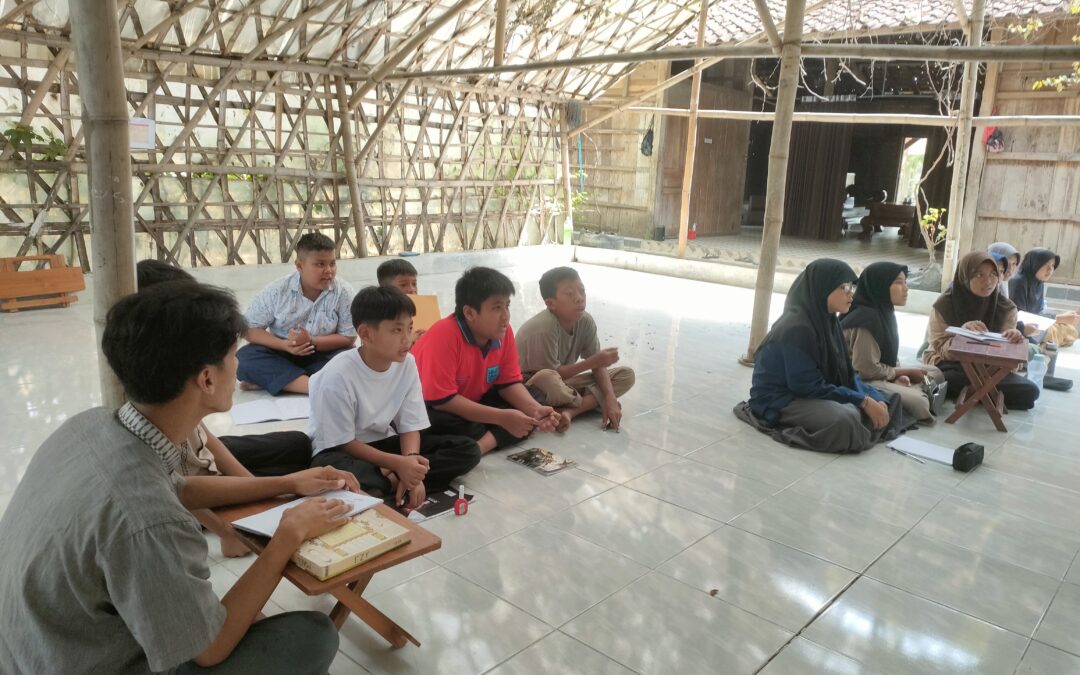
Although this test covers three foreign languages, this writing focuses on the English diagnostic test. This test, administered by the English teacher, determines students’ proficiency level. Conducted at the start of the academic year, the test lasts about one hour and takes place at 8:00 PM for around junior high school students who choose English class. Since it is a boarding school program, regular classes are less significant. As it affects class placement, students approach it seriously during the test. Considering that the results impact their future class placements.
Rupp in his journal describes diagnosis as the process of precisely identifying, deciding, and agreeing upon a course of action, while Zhongbao Zhao highlights its role in guiding teaching and learning improvements. Zhongbao Zhao adds that the primary purpose of diagnostic tests is to provide feedback to both teachers and students, aiding in making decisions about teaching and learning improvements. Thus, the diagnostic test at SMP Alam Nurul Furqon identifies three English proficiency levels: basic, intermediate, and advanced; with an average of 10 students per class level. The total class distribution is as follows: 1 advanced class, 1 intermediate class, and 3 basic classes. Beyond just assessment, teachers also need to identify which parts of the questions reveal weaknesses and which areas show sufficient understanding.
This diagnostic test is designed to assess students’ initial understanding of concepts and identify areas needing additional support. It helps identify specific topics or skills students must master so teaching can be tailored to individual needs. Teachers can then develop effective learning strategies to address weak areas. For instance, the writer has the opportunity to teach the English Intermediate class for one semester. Based on the test results, the students have a foundational knowledge of English and some vocabulary. The semester’s learning plan will focus on grammar, such as parts of speech, and advanced tenses like Present Continuous and Present Perfect. This differs from the advanced level, which emphasizes speaking, and the basic level, which emphasizes everyday vocabulary.
The quality of the diagnostic test is also essential to ensure it effectively identifies students’ needs and abilities, encompassing validity and reliability standards. In terms of validity at SMP Alam Nurul Furqon, the test accurately measures the intended understanding or skill, such as grammar or listening. While, in terms of reliability, it reflects consistent results. Attention to these aspects enables the diagnostic test to help teachers understand students’ needs, facilitating more targeted and effective instruction. The diagnostic test can become an effective tool to help teachers understand students’ learning needs and plan more targeted instruction.